


Introduction
Children today grow up in a world shaped by complex environmental and technological hazards. These hazards include climate change, radiation exposure, infrastructure failure, and space-related risks. Many of these hazards are difficult to see, slow to unfold, or embedded in large technical systems. Because of this, understanding hazards requires more than knowing isolated scientific facts. It also requires reasoning about uncertainty, long-term consequences, and social responsibility. Hazard literacy therefore plays an important role in both science education and civic education [1–3].
Hazard literacy refers to the ability to understand how hazards arise, how risks are distributed, how people can adapt or mitigate harm, and how ethical and social factors shape vulnerability [1–3]. Prior research emphasizes that children are not only future decision-makers but also current members of families and communities who interpret risk information and participate in preparedness practices [2,4]. Developing hazard literacy at an early age can support children’s capacity to reason about potential impacts, evaluate responses, and reflect on fairness and responsibility when facing uncertain risks [1,3,5].
However, many hazards are abstract or unobservable in everyday life. Phenomena such as solar storms, atmospheric loss, radiation exposure, or cascading technological failures cannot be directly experienced or safely reproduced in classrooms [2,6]. These hazards unfold across long time scales and involve hidden infrastructures, making them difficult for young learners to conceptualize. As a result, conventional hazard education often focuses on familiar, short-term natural hazards and procedural safety messages, such as evacuation drills or preparedness checklists [4,5]. While such approaches can increase basic awareness, they provide limited opportunities for students to reason about systemic causes, uncertainty, or ethical dimensions of hazard situations [1–3,7].
To address these limitations, scholars have proposed imagination-based approaches, including science fiction (SF) and speculative scenario work, as productive tools for hazard education [7–10]. SF allows learners to explore scientifically plausible but unfamiliar futures. Through worldbuilding and narrative design, students can reason about large-scale hazards, technological trade-offs, and social consequences that cannot be observed directly. Prior studies show that SF-based learning can support scientific explanation, motivation, and socio-scientific reasoning [8–10]. However, despite this potential, few studies have examined how SF activities support hazard literacy, particularly among elementary-aged learners.
This study addresses this gap by examining how upper-elementary students engaged with hazard literacy while collaboratively designing a branching SF game scenario in an informal science program. Students worked together to imagine a future affected by geomagnetic weakening, atmospheric loss, nuclear system failure, and planetary adaptation. By analyzing their collaboratively written scenario, mentor-produced growth records, and the instructor’s reflective report, this study explores how scientific, social, and ethical dimensions of hazard reasoning emerged through collaborative speculative design.
Guided by this context, the study is framed by the following research question:
Background
Hazard literacy is a multidimensional concept that includes scientific understanding, risk and uncertainty reasoning, mitigation and adaptation, and ethical and social judgment [1–3]. Scientific understanding refers to how hazards arise, propagate, and interact with natural and human systems [2,3]. Risk and uncertainty reasoning involves judging likelihood, limits of knowledge, and potential consequences, which are often shaped by affect and social trust rather than by information alone [11]. Mitigation and adaptation include both immediate protective actions and long-term strategies to reduce vulnerability [2,3]. Ethical and social reasoning addresses how hazard impacts are unevenly distributed and shaped by social, political, and infrastructural conditions [1,3,6].
Although these components are conceptually linked, they are often addressed separately in educational practice. Many hazard education programs for children emphasize factual knowledge or procedural preparedness, such as evacuation rules or safety drills [4,5]. These approaches tend to focus on visible, short-term natural hazards and provide limited opportunities to reason about slow-onset, technological, or large-scale hazards [1–3]. As a result, learners may know what to do in familiar emergencies but have few chances to explore uncertainty, systemic causes, or ethical dilemmas related to hazards that exceed everyday experience.
Hazard literacy is particularly difficult to cultivate when hazards are abstract or unobservable. Hazards such as solar storms, atmospheric erosion, radiation exposure, or cascading system failures unfold over long time scales and involve hidden infrastructures [2,7]. Young learners cannot directly observe these processes, nor can they be safely reproduced in classrooms. This makes it challenging for students to develop coherent mental models of how hazards work and how human decisions shape risk and vulnerability [6,12].
To address these challenges, researchers have highlighted the role of imagination and narrative in supporting reasoning about complex hazards [13–16]. Reasoned imagination allows learners to explore multi-step and cascading hazard scenarios that cannot be empirically tested in school settings [7]. Narrative structures help learners organize events, decisions, and consequences, supporting causal reasoning and sense-making under uncertainty [15,17]. Through narrative, learners can externalize their thinking and revise their understanding as stories evolve.
Science fiction (SF) extends these narrative affordances by combining imaginative freedom with scientific plausibility, situating scientific ideas in meaningful future contexts that foreground technological risk, resource scarcity, and governance failure [8-10]. Despite this potential SF worlds often foreground technological risk, resource scarcity, governance failure, and uneven vulnerability, making them particularly relevant for hazard literacy [7–10].
However, despite this potential, SF has rarely been examined as a tool for hazard literacy development, especially among elementary-aged learners. Existing work involving children often focuses on disaster communication or post-event recovery rather than on how learners reason about hazards before they occur [11]. Moreover, few studies examine how scientific, ethical, and social dimensions of hazard reasoning interact during collaborative speculative design. This study builds on these gaps by using SF scenario design as a context for examining how multiple dimensions of hazard literacy emerge through collaborative narrative construction.
Framework
This study draws on two complementary pedagogical perspectives: design-based learning (DBL), narrative-centered learning, and speculative-fiction pedagogy. This enables us to interpret how students reasoned about hazards while collaboratively building a science-fiction (SF) game scenario. Across these perspectives, hazard literacy serves as the analytic lens for examining how scientific, ethical, and socio-technical ideas were represented in students’ design decisions.
DBL is characterized by open-ended problem spaces, iterative refinement, and the integration of domain knowledge into artifact construction. Prior research shows that design tasks promote systems thinking, creativity, and the coordination of scientific ideas with practical constraints [18–21]. Worldbuilding for an SF game can be understood as a DBL activity: as students design environments, technologies, and threat dynamics, they externalize causal mechanisms and negotiate trade-offs; processes directly aligned with hazard systems reasoning.
Narrative-centered learning highlights how story structures support reasoning about causality, uncertainty, and consequences. Narrative environments position learners within evolving storylines that require evidence-based interpretation and decision-making, and are associated with gains in motivation, presence, and conceptual integration [22]. However, narrative effectiveness depends on alignment between story structure and learning goals [23,24]. When narratives demand explanations, such as reasoning through characters’ choices or consequences, learners integrate ideas more deeply [25]. In this project, narrative functions as the primary medium through which hazard mechanisms and risk evaluations become meaningful within lived experiences of characters.
In this study, these two pedagogical perspectives were deliberately selected to focus analytic attention on how students reasoned hazards through collaborative design and storytelling. Rather than examining individual cognition, learning outcomes, or interactional discourse, the analysis centers on how ideas about hazards were externalized, negotiated, and stabilized within a shared design artifact. DBL foregrounds processes of iterative revision and constraint negotiation as central mechanisms for reasoning in open-ended problem spaces [18–21]. Narrative-centered learning directs attention to how causal relations, uncertainty, and consequences are structured through story-based decision points [22–25]. Within this focused analytic scope, hazard literacy functions as the primary lens for interpreting how scientific explanations, risk judgments, mitigation strategies, and ethical considerations were integrated into students’ design decisions.
Methods
This study employed a qualitative case study design to examine how upper-elementary students developed hazard literacy while collaboratively writing a science-fiction (SF) game scenario. A case study approach was appropriate because the goal was to understand a bounded instructional setting in depth rather than to produce generalizable findings. A case was conceptualized as a real-life, bounded system examined through multiple qualitative data sources over time, with attention to contextual detail and interpretive meaning [26].
The case in this study was a ten-week informal science program in which seven students collaboratively designed and revised a branching SF game scenario. The program was selected because it provided sustained opportunities for students to engage with large-scale and abstract hazards that are difficult to observe directly, such as space weather, nuclear systems, and planetary environments. The design-oriented and narrative-centered structure of the program allowed examination of how students demonstrated the four dimensions of hazard literacy through collaborative decision-making [26].
The study was conducted in a university-affiliated weekend science enrichment program located in a metropolitan area in South Korea. The program met once per week for approximately four hours across ten weeks. Instruction combined scientific exploration, discussion, and collaborative SF scenario and game design. Seven students aged 10–12 voluntarily participated. Pseudonyms are used throughout this article, and all identifying information has been removed.
The instructional sequence was organized to gradually support students’ engagement with hazard concepts before scenario construction, as seen from Table 1. In the early sessions, students explored a range of hazard-related scientific topics using presentation slides, worksheets, discussion prompts, and short SF examples. Session 1 focused on asteroid impacts and included a pre-survey to elicit students’ prior ideas about hazards, science, and SF. Session 2 addressed nuclear energy, including atomic structure, nuclear power generation, and radioactive waste, with students discussing risks, benefits, and ethical trade-offs.
Sessions 3 and 4 involved preparatory classroom instruction and a field-based investigation at Deoksugung Palace. Students examined how architectural features, such as materials, roof structures, and spatial orientation, respond to environmental conditions including sunlight, temperature, and seasonal change (Fig. 1A; students presenting their findings). These observations were later connected to discussions of solar energy, solar storms, and Earth’s magnetic field. Session 5 focused on climate systems, ice ages, rapid climate change events, and geoengineering, using visual models and guided discussion.
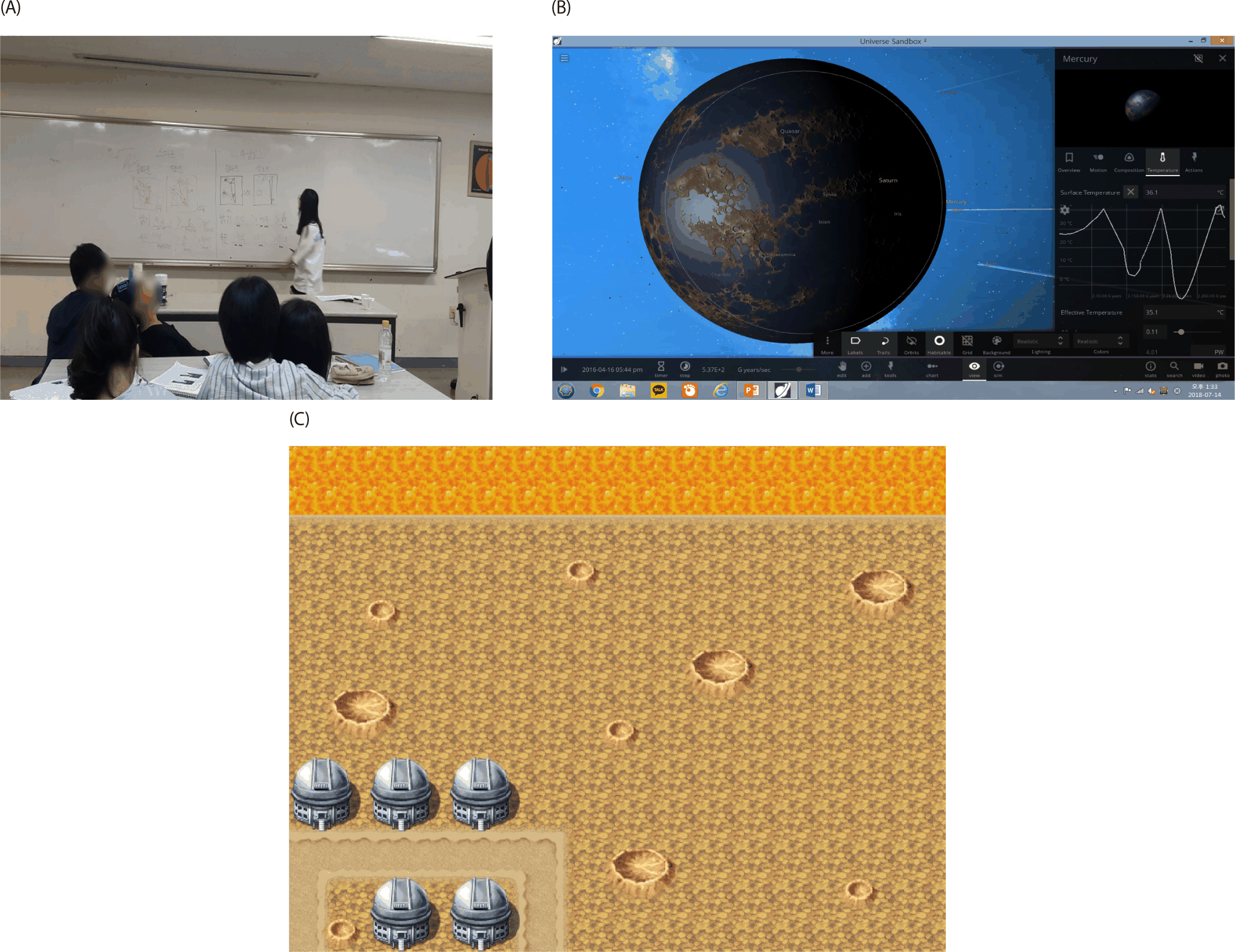
From Sessions 6 to 10, instruction emphasized constrained imagination through hard SF and speculative scientific frameworks. Students read and discussed the hard SF novel Mission of Gravity, focusing on how gravity and planetary conditions shape biology, culture, and technology. Subsequent sessions addressed terraforming by comparing planetary data and environmental constraints, attempting terraforming through Universal Sandbox 2 (Fig. 1B), and time travel by examining scientific limits, causality, and paradoxes through special relativity and SF examples. In Session 10, students were explicitly introduced to SF and scenario design, including loglines, three-act structure, branching narratives, and game storytelling, using presentation materials and structured activities.
From Session 11 onward, students collaboratively wrote and revised a branching SF game scenario (Fig. 1C; students made tangible background using RPG Maker). They developed characters, settings, hazards, and decision points grounded in previously explored scientific concepts, including geomagnetic weakening, atmospheric loss, nuclear systems, and planetary settlement. The final collaboratively produced scenario log served as a primary data source for analysis. The summary of the scenario log is presented in Table 2.
This table summarizes the core narrative structure of the collaboratively designed science-fiction scenario, highlighting the scientific constraints, hazard mechanisms, and decision points that served as the basis for analysis. Detailed plot variations and endings were not analyzed individually but were examined as part of students’ reasoning about risk, adaptation, and responsibility.
Throughout the program, the instructor guided learning through questioning and discussion rather than by providing fixed answers. When scientific inconsistencies or narrative tensions arose, the instructor prompted students to justify assumptions, reconsider constraints, and revise their ideas collaboratively.
Three qualitative data sources were analyzed in this study. The primary data source was the collaboratively written SF game scenario produced by the students. The scenario underwent three major revisions over approximately four weeks (Sessions 11-14): an initial 800-word outline introducing the basic premise; a first revision (~1,200 words) incorporating causal mechanisms after instructor-led discussion on scientific plausibility; and a final revision (~2,200 words) adding branching decision points, ethical dilemmas, and multiple endings following sessions on narrative structure. Each version documented students’ evolving representations of scientific mechanisms, hazard dynamics, technological constraints, branching decisions, and ethical dilemmas related to planetary risk, survival, and governance. The scenario functioned both as a narrative artifact and as a record of students’ developing hazard reasoning.
The second data source consisted of mentor-produced student growth records. These records were written by the instructor in the role of mentor and documented individual students’ participation patterns, conceptual understanding, collaboration styles, and notable changes over time. The growth records provided insight into how different reasoning tendencies and interactional roles shaped contributions to the shared scenario.
The third data source was the instructor’s reflective report, which documented the instructional intentions, observed group dynamics, and pedagogical decisions across the program. This report was used to contextualize the instructional design and to support interpretation of how activities and scaffolds shaped students’ engagement with hazards.
No interviews with students were conducted, and no audio or video recordings of classroom interactions were included in the analysis. Although sessions were informally recorded, these materials were not systematically archived or prepared for analytic use and were therefore excluded. As a result, students’ reasoning is represented primarily through written artifacts and mentor and instructor reflections rather than through verbatim conversational data.
This study was conducted as part of an educational enrichment program. Participation was voluntary, and parental consent was obtained for the use of student work for research purposes. All student names were replaced with pseudonyms, and identifying details related to schools or locations were removed. Data were analyzed retrospectively, and all materials were handled in accordance with institutional guidelines for research involving minors.
Given the absence of interviews or recorded interactional data, particular care was taken to avoid over-attribution of individual intentions or emotions. Interpretations focused on patterns evident in written artifacts and documented reflections rather than speculative reconstruction of students’ internal states.
Author analyzed the data using qualitative content analysis with two linked cycles: (1) directed coding based on the four hazard-literacy dimensions and (2) inductive coding to capture patterns not fully explained by that framework [27–29]. I treated the analysis as an iterative process of reading, coding, comparing across drafts, and writing analytic memos that were later consolidated into the final findings [26,27].
First, I prepared the dataset. I organized the three major versions of the collaboratively written SF scenario in chronological order. I also organized mentor growth records and the instructor reflective report as contextual documents. I then segmented the scenario texts into “meaningful units.” A unit was a short narrative segment that expressed a hazard mechanism, a risk judgment, a decision point, a mitigation or adaptation move, or an ethical–social dilemma. This unit definition allowed consistent comparison across revisions.
Second, I conducted directed coding. I began with a codebook aligned with the four hazard-literacy dimensions: (a) scientific understanding of hazard-related phenomena, (b) risk perception and sense-making, (c) mitigation and adaptation strategies, and (d) ethical and sociopolitical reasoning. For each dimension, I created brief operational rules in plain language (e.g., what counts as “scientific mechanism” versus a general description). I applied these codes to the first scenario version and wrote short memos to note uncertain cases and recurring patterns. I then coded the second and third versions using the same codebook, while noting when the same unit became more detailed, more causal, or more ethically complex. This step produced a draft-level view of how each hazard-literacy dimension appeared and changed across revisions.
Third, I conducted inductive coding. After the directed pass, I re-read the scenario units and marked patterns that were important for interpretation but did not fit cleanly within the four dimensions. These included repeated narrative moves (e.g., creating branching consequences), forms of collaboration reflected in the text (e.g., compromise solutions that combine competing ideas), and epistemic stances expressed through language (e.g., hedging under uncertainty versus asserting authority). I grouped these inductive codes into higher-level categories through constant comparison across units and across drafts [27,28]. I refined category definitions by checking whether each category appeared in multiple places and whether it helped explain draft-to-draft change.
Fourth, I integrated the two coding cycles into themes. I used the directed codes to ensure that interpretations remained anchored in hazard literacy, and I used the inductive categories to explain how hazard literacy was expressed and negotiated through scenario design. Practically, I created a matrix that mapped: (a) hazard-literacy dimension(s), (b) inductive category, (c) scenario unit, and (d) draft version. I then wrote theme memos by tracing clusters in this matrix. These memos became the basis for the four results themes and for addressing both research questions.
Fifth, I used the three data sources in a triangulated but bounded way. The scenario drafts were treated as the primary evidence for students’ expressed hazard reasoning. Mentor growth records and the instructor reflective report were used to clarify activity context, timing, and instructional scaffolds, and to check whether my interpretations of scenario units aligned with documented classroom intentions and observations [26,29,30]. Because I did not analyze interview or interaction transcripts, I avoided claims that would require direct access to students’ spoken reasoning. Instead, I grounded claims in written scenario evidence, supplemented by mentor and instructor documentation.
Findings
The analysis shows that students’ collaborative SF scenario design revealed multiple dimensions of hazard literacy. Drawing on both directed codes from the analytic framework and inductively generated codes, four themes illustrate how students engaged with scientific mechanisms, uncertainty, adaptation, and ethical–social reasoning. In reporting each theme, directed and inductive codes are presented together, because students’ ideas did not emerge as separate categories; instead, their scientific, narrative, and social reasoning developed in tightly connected ways throughout the collaborative design process. Across themes, directed codes based on the hazard literacy framework and inductively generated codes are presented together to reflect how students’ scientific, narrative, and social reasoning developed in an integrated manner rather than as separable categories.
Across the scenario drafts, students increasingly treated hazards not as sudden catastrophic events but as systems that unfold through causal mechanisms, constraints, and time-dependent processes. This shift became visible as students revised how hazards were explained, moving from event-based descriptions to process-oriented reasoning embedded within the shared SF world.
In the initial draft, hazards were typically introduced as abrupt plot triggers. For example, a solar storm was described as occurring suddenly, disabling electronic systems and forcing immediate evacuation. At this stage, the hazard served mainly to justify rapid narrative action. The scenario did not yet explain how the storm affected Earth’s protective systems or why its consequences would persist over time.
In later drafts, students revised this explanation by explicitly linking the hazard to underlying physical mechanisms. In the final scenario log, the weakening of Earth’s magnetic field was described as allowing high-energy solar particles to reach the planet’s surface, resulting in gradual atmospheric loss. One passage explains:
“Because the magnetic field could no longer block the solar wind, the atmosphere slowly became thinner, and people started to experience problems long before the Earth became uninhabitable.”
This revision marks a clear shift from instantaneous collapse to accumulation and delay. Rather than depicting a single moment of disaster, students framed the hazard as a long-term process with uncertain thresholds. The emphasis on “long before” indicates attention to early warning signs and partial degradation rather than total failure.
Students extended this systemic reasoning by connecting multiple hazard mechanisms within the same scenario. In the space-travel storyline, nuclear power was initially introduced as a technical solution that enabled long-distance travel. In later drafts, students revised this portrayal to account for secondary risks. One branch describes that damage to a nuclear system led to radiation exposure and conflict among crew members, noting that:
“Using nuclear power made the trip possible, but it also created a situation where one mistake could threaten everyone on board.”
Here, nuclear technology is no longer a neutral solution. It becomes both mitigation and hazard, requiring students to reason about interacting systems and cascading consequences.
Constraints played a central role in shaping these explanations. In descriptions of planetary settlement, students explicitly accounted for gravity, atmospheric composition, temperature, and radiation. Rather than assuming full environmental control, they proposed partial adaptations such as domed habitats and restricted movement. These proposals were accompanied by explicit statements of infeasibility, as illustrated, “Even if people wanted to change the planet completely, the gravity was too weak to keep an atmosphere like Earth’s.”
Such statements indicate that students were not only proposing solutions but also reasoning about why certain solutions could not work, given physical limits.
Across drafts, these revisions show how collaborative worldbuilding functioned as a space for shared scientific reasoning. By repeatedly revising explanations within a common narrative world, students externalized causal assumptions, tested them against constraints, and refined their understanding of hazards as Systemetic event rather than isolated events.
Across the scenario drafts, students increasingly framed risk as a condition that required judgment under uncertainty rather than as a problem that could be solved through a single technical solution. This shift became visible as students introduced uneven protection, secrecy, and branching decisions that produced different consequences for different groups.
In an early draft, students introduced planetary risk as a scientific discovery followed by an expert-led response. The scenario describes that:
“Scientists discovered that the Earth’s magnetic field was slightly weakened and could no longer fully block solar wind, predicting that Earth’s atmosphere would gradually disappear.”
At this stage, risk is presented as a factual prediction. The scenario moves quickly from scientific diagnosis to action, without questioning how this knowledge circulates or who is affected first. The hazard exists, but uncertainty and social consequence remain underdeveloped.
In later drafts, students reworked this situation by embedding risk within social and political constraints. When a protective dome is introduced, the scenario explicitly states that, “Because the number of people who could live inside the dome was limited, only a privileged group was allowed to enter, while ordinary citizens remained unaware of the situation.” This revision marks a significant shift in risk reasoning. Risk is no longer universal but unevenly distributed. Protection becomes scarce, and uncertainty is managed through secrecy rather than shared knowledge. This move reflects a transition from technical mitigation to socio-technical risk reasoning, where solutions themselves generate new forms of vulnerability.
Students further explored uncertainty by introducing branching decisions tied to authority and disclosure. In one branch, a government official faced a choice. “Although the Minister of Defense belonged to the privileged group, after much deliberation, he decided to leak the information.” And the decision does not resolve the hazard. Instead, it reshapes the risk landscape. Subsequent branches describe divergent outcomes, including social unrest and collective resistance. Here, students treated uncertainty not as a lack of information to be eliminated, but as a condition that forces ethical and political choice. The scenario format allowed them to explore how the same hazard could lead to different futures depending on who acts and what values guide that action.
Risk reasoning also became more complex in the context of planetary evacuation. When students introduced a temporal constraint, the scenario explains:
“There were only 100 years left before Earth became uninhabitable, and it was decided that only a small number of people would be selected to settle on another planet as a pilot group.”
Rather than framing selection as a neutral logistical step, later revisions emphasize disagreement and moral tension surrounding who should leave and who should remain. Risk, in this sense, is tied to responsibility and sacrifice, not merely survival.
Finally, students connected uncertainty to technological trade-offs during space travel. One branch describes:
“Because of the weight and distance involved, nuclear power was chosen as the energy source, but problems caused by nuclear failure led to many people being injured or killed before the spacecraft arrived on Mars.”
Here, mitigation and risk collapse into one another. Nuclear power enables escape while simultaneously introducing catastrophic secondary hazards. This narrative move reflects students’ growing attention to trade-offs under constrained conditions, where no option is fully safe.
Taken together, these patterns show that students used branching narrative structures to reason about risk as an ongoing, negotiated condition shaped by limited knowledge, unequal power, and irreversible choices. Rather than seeking optimal solutions, students explored how different decisions redistributed risk and produced divergent, imperfect futures.
Across scenario drafts, students increasingly framed hazards not only as scientific or technical problems but as ethical situations involving responsibility, fairness, and uneven vulnerability. Rather than treating survival as a purely logistical challenge, students used the scenario to explore who should be protected, who bears risk, and how moral responsibility shifts under conditions of scarcity and uncertainty.
In early drafts, ethical considerations were largely implicit. Protective measures such as the construction of a dome were introduced as necessary responses to planetary danger, but questions of access and responsibility were not yet foregrounded. Survival was framed as a collective goal, and moral tension remained underdeveloped.
In later drafts, students revised the scenario to make ethical conflict explicit by introducing unequal access to protection. The scenario states:
“Because only a limited number of people could live inside the dome, only a privileged group was allowed to stay there, while ordinary citizens remained unaware of the situation.”
This revision marks a shift from collective survival to differentiated vulnerability. Protection becomes conditional, and ethical tension emerges from exclusion rather than from the hazard itself. By specifying that information was withheld from the general population, students linked vulnerability not only to physical exposure but also to access to knowledge.
Students further developed ethical reasoning by introducing individual responsibility within positions of power. In one branch, a government official faced a moral dilemma, such as “Although the Minister of Defense belonged to the privileged group, after much deliberation, he decided to leak the information.” This decision, by any means, does not resolve the hazard. But it does reconfigure ethical responsibility. By choosing disclosure, the official assumes ethical accountability for the consequences that follow, including social unrest and conflict. Here, responsibility is framed not as obedience to authority or technical expertise, but as a choice made under moral pressure and uncertainty.
Ethical reasoning also emerged in students’ treatment of intergenerational and collective responsibility. When the scenario introduced a long time horizon, stating that Earth would become uninhabitable in approximately one hundred years, students framed present decisions as shaping the lives of future populations. Selection for off-world settlement was described not merely as an opportunity, but as a burden that redistributed risk across groups and generations.
Students extended these concerns to encounters with nonhuman others. In planetary settlement storylines, later drafts introduced the possibility of indigenous life or existing inhabitants. Although these entities were initially treated as obstacles, subsequent revisions framed them as moral subjects whose survival and autonomy required consideration. This shift reframed colonization and terraforming as ethical choices rather than technical achievements.
Across drafts, these developments indicate that students used the shared SF world to reason about justice and responsibility under hazardous conditions. Ethical questions did not appear as abstract principles but emerged through narrative decisions that made vulnerability visible and forced trade-offs between competing values. By embedding these dilemmas within consequential storylines, students explored how ethical reasoning becomes inseparable from scientific and political decision-making in contexts of large-scale risk.
Across the scenario design process, students’ ethical and sociopolitical reasoning was not expressed solely through abstract principles but was actively shaped by emotional engagement during collective deliberation. Mentor records documented that students’ contributions to discussions about ethical dilemmas were accompanied by affective expressions (e.g., frustration, empathy, moral urgency).
In early drafts, ethical concerns were present but remained implicit. Inequality was introduced through narrative description rather than deliberation. For example, the scenario described, “Most people were left outside the dome without knowing the danger, while an elite group secretly prepared to survive inside.” At this stage, exclusion is depicted as a condition of the world, not yet as a contested ethical problem. The narrative establishes injustice, but characters do not actively respond to it, and moral reasoning remains underdeveloped.
In later drafts, ethical reasoning became more explicit and emotionally charged as students debated responsibility for harm. One pivotal revision involved the introduction of a self-sacrificing character. This narrative turn followed a discussion in which Student C argued, “If someone caused the danger, then someone has to take responsibility for it.” Mentor records describe this moment as carrying strong affective force, noting heightened engagement and a shift in group consensus. Analytically, this moment marks a transition from diffuse responsibility to personalized moral accountability. Emotion here functions as a catalyst that moves ethical reasoning from abstract fairness to concrete obligation.
Students also incorporated narrative elements representing sociopolitical conflict and resistance, such as sabotage as protest against exclusionary decision-making. In one discussion, the group debated whether a frustrated crew member might intentionally damage a hatch or disrupt dome operations as a form of protest against exclusionary decision-making. This possibility was reflected in later scenario branches that framed sabotage as a response to perceived injustice rather than as irrational violence.
During this debate, mentor records documents contrasting emotional stances. Student D was described as hesitant and uneasy, expressing concern that sabotage would endanger people who had no control over the original decision. In contrast, Student B became increasingly animated when discussing fairness, “If people are excluded from important decisions, it makes sense that they would resist.” These exchanges show students reasoning about power, legitimacy, and moral justification through emotionally grounded perspectives. Rather than evaluating actions solely by outcome, students considered intent, authority, and structural exclusion, using emotional reactions to test the moral limits of resistance.
Across drafts and discussions, emotional engagement enabled students to grapple with ethical and sociopolitical dimensions of hazard that exceeded technical risk assessment. Feelings of frustration, empathy, and moral tension were not incidental but integral to how students reasoned about justice, responsibility, and collective decision-making under hazardous conditions. Along with affectively engaged discussion, students articulated values and power relations embedded within their fictional world, demonstrating that ethical hazard literacy emerged through interpersonal negotiation as much as through scientific explanation.
Discussion
This study examined how upper-elementary students engaged with hazard literacy through collaborative science-fiction (SF) scenario design. By analyzing students’ evolving scenario drafts alongside mentor records, the findings reveal how each of the four dimensions of hazard reasoning developed in complexity across the collaborative design process.
Across the findings, students did not treat hazards as singular events or purely technical problems. Instead, they increasingly represented hazards as systems governed by causal mechanisms, constraints, and time-dependent processes. Through repeated revision of shared narrative artifacts, students externalized scientific assumptions, tested them against physical limits, and refined explanations over time. This pattern aligns with prior work suggesting that design-based activities support systems-level reasoning by requiring learners to coordinate domain knowledge with constraints and consequences [18–21]. In this study, worldbuilding functioned as a design space in which scientific reasoning became visible, negotiable, and revisable.
Importantly, students’ reasoning about hazards extended beyond scientific mechanisms to include judgments under uncertainty. Rather than seeking optimal or definitive solutions, students used branching narrative structures to explore how different decisions redistributed risk across groups and time scales. Uneven protection, secrecy, and partial information became central narrative elements through which students reasoned about uncertainty as a persistent condition rather than a problem to be eliminated. These findings support prior claims that narrative-centered learning environments can foreground causality and consequence by situating learners within decision-rich storylines [22–25]. In the present study, narrative branching enabled students to examine how authority, knowledge circulation, and value commitments shape risk outcomes.
The findings also highlight how adaptation strategies were inseparable from ethical and sociopolitical reasoning. Students’ proposals for domes, evacuation, or planetary settlement were not treated as neutral technical responses. Instead, they became sites of moral tension involving responsibility, sacrifice, and uneven vulnerability. Decisions about who should be protected, who should bear risk, and who should act under constraint were repeatedly negotiated through the scenario. This suggests that adaptation reasoning, particularly in large-scale hazards, cannot be fully understood without attending to ethical and political dimensions embedded in design decisions [10,31–33].
A key contribution of this study is the observed alignment between emotional engagement and ethical reasoning. Emotional responses observed in group deliberations such as frustration, empathy, and moral urgency, were not incidental but functioned as mechanisms that shaped how students evaluated responsibility, legitimacy, and resistance. Rather than expressing ethical principles abstractly, students articulated values through emotionally charged negotiation around contested narrative choices. This finding extends prior SF-based educational research by showing how speculative settings can support not only futures thinking and ethical imagination but also emotionally grounded deliberation about justice and power [10,31–33].
Taken together, these findings suggest that hazard literacy emerges through integrated practices rather than discrete instructional targets. Scientific understanding, risk judgment, adaptation planning, and ethical–social reasoning developed in tightly coupled ways through collaborative scenario design. By treating the SF world as a shared, revisable artifact, students were able to explore hazards that exceed everyday experience while grappling with uncertainty, constraint, and responsibility. This integrated view of hazard literacy has implications for hazard education, which often emphasizes factual knowledge or preparedness behaviors while underemphasizing ethical and sociopolitical dimensions of risk.
At the same time, this study contributes methodologically by demonstrating the analytic value of written design artifacts for examining students’ hazard reasoning. Rather than relying on interviews or pre/post measures, the analysis traced how reasoning became visible through draft-to-draft change, narrative structure, and documented deliberation. This approach foregrounds how learning unfolds through collective design practice and offers a complementary perspective to interaction-focused or assessment-driven studies of hazard education [26–30,34].
Several limitations should be acknowledged. First, the analysis did not include interviews or audio/video recordings of classroom interaction. Although some sessions were informally recorded, these materials were not systematically archived and were therefore excluded from analysis. As a result, interpretations of students’ reasoning are grounded primarily in written scenario texts and mentor records rather than in fine-grained discourse analysis. While this limits access to moment-by-moment interactional detail, it also aligns with the study’s focus on design artifacts as sites where reasoning was stabilized and revised.
Second, the study examined a single instructional case involving a small group of students within an informal enrichment program. The findings are therefore not intended to be generalizable but to provide an in-depth account of how hazard literacy can emerge through collaborative SF design in a bounded context [26]. Future research could extend this work by examining similar approaches across diverse settings, age groups, or hazard domains.
Finally, mentor records were used to contextualize and interpret scenario revisions but were not treated as independent evidence of students’ internal states. This analytic choice prioritizes observable design decisions and documented deliberation while avoiding speculative claims about individual cognition. However, it also means that affective and interactional processes are interpreted indirectly. Future research could extend this work by examining similar approaches across diverse settings, age groups, or hazard domains, and by incorporating interactional data (e.g., audio/video recordings) to investigate how the dimensions of hazard reasoning are negotiated and integrated during collaborative design processes.


